Businesses accustomed to planning their iPhone upgrades around September may need to rethink that strategy.
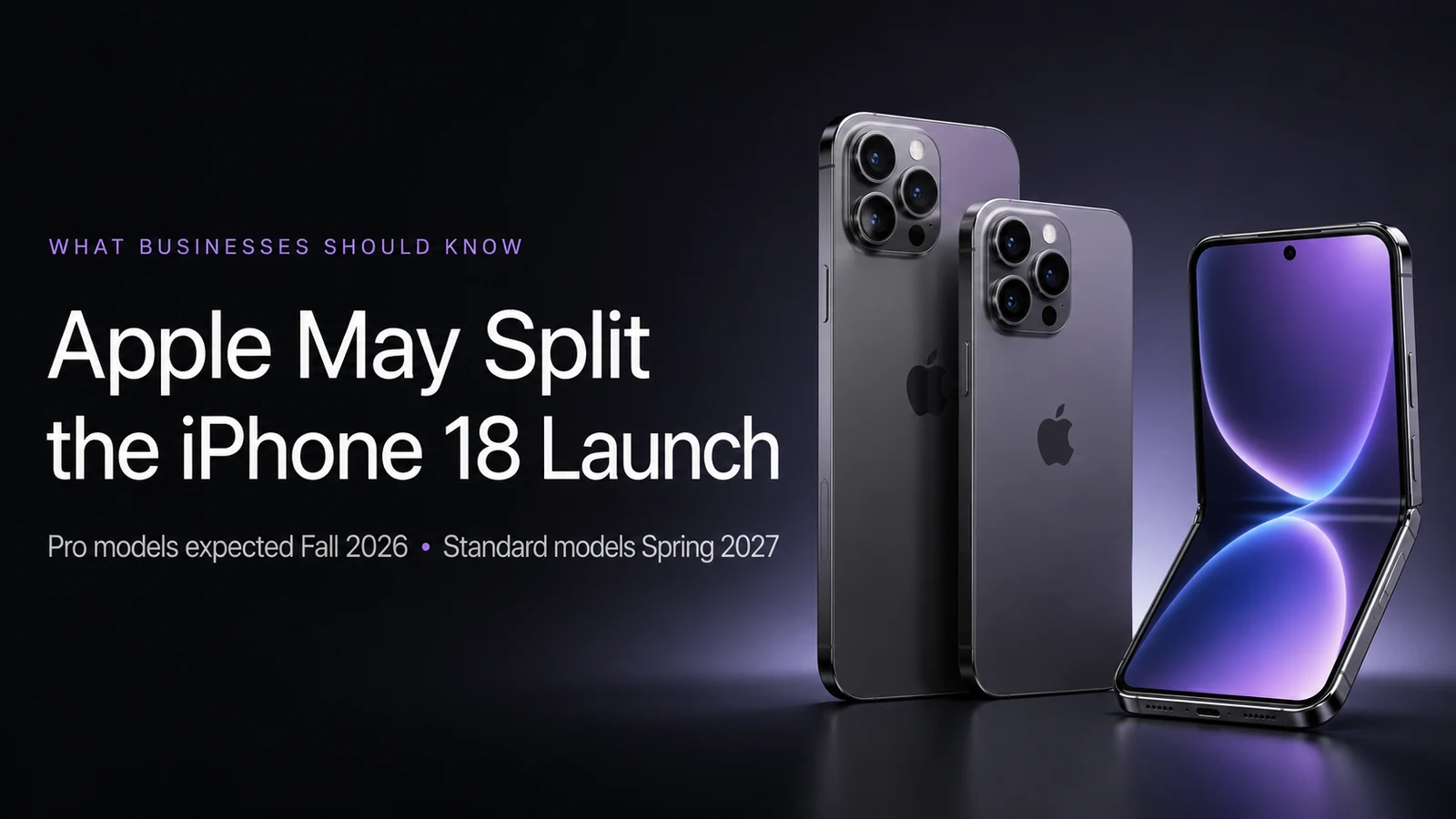
Apple appears to be preparing one of the biggest changes to its iPhone release calendar in more than a decade: instead of introducing its mainstream and premium iPhones together in the fall, the company is expected to divide the iPhone 18 generation between fall 2026 and spring 2027.
For an individual buying one phone, a six-month difference may simply mean deciding whether to wait. For a company responsible for dozens, hundreds or thousands of devices, the decision can affect budgets, upgrade eligibility, deployment schedules, inventory availability and carrier promotions.
✓ iPhone 18 Pro Max
✓ Foldable iPhone, widely reported as iPhone Ultra
✓ iPhone 18e
✓ iPhone Air 2
Why This Would Be Such a Major Change
Apple has established a remarkably predictable fall iPhone cycle. The standard iPhone and its Pro counterparts have traditionally arrived together, allowing customers and businesses to compare the generation at roughly the same time.
The reported iPhone 18 strategy would change that. Businesses looking for Apple’s regular mainstream model may not have a new standard iPhone to purchase during the traditional September upgrade season.
Instead, Apple’s most expensive models would get the fall spotlight while the standard and entry-level devices would arrive several months later.
The Supply Chain Is Adding Evidence
This is no longer based on a single rumor.
During Pegatron’s second-quarter 2026 earnings call, the major electronics manufacturer reportedly indicated that one customer’s normal smartphone shipment schedule was changing. Reporting connected that change to Apple’s standard iPhone 18 moving into the first quarter of 2027.
Largan Precision, a major smartphone camera-lens supplier, provided another clue. Chairman Lin En-ping said a major U.S. customer had postponed a new model until the first quarter of 2027.
Neither supplier publicly named Apple, so those statements should not be treated as an official Apple announcement. But they closely match the previously reported iPhone 18 roadmap.
Reports examining iOS 27 beta 5 found six unreleased Apple device identifiers in battery-related system files.
V63 — associated with iPhone 18 Pro
V64 — associated with iPhone 18 Pro Max
V67 — associated with iPhone 18
V68 — associated with Apple’s foldable iPhone
V69 — associated with iPhone 18e
The identifiers are present in Apple’s software. The retail product names associated with them are based on reporting and have not been confirmed by Apple.
Why Would Apple Split the Launch?
There probably isn’t one single reason.
Analyst Ming-Chi Kuo previously reported that moving to two major iPhone launch windows could help Apple compete with rival smartphone manufacturers that introduce important flagship devices during the first half of the year. It would also prevent Apple’s expanding lineup from competing with itself for attention during one massive fall launch.
Manufacturing is another consideration. Apple is moving toward a much larger iPhone lineup, including its first foldable device. Spreading those launches across the calendar can distribute production requirements instead of forcing every model into the same manufacturing window.
Apple’s supply constraints are real, but it would be misleading to say they are proven to be the reason Apple created the split-launch strategy. Reports of the staggered release plan appeared before the current shortages became as severe as they are today.
Apple has acknowledged having less supply-chain flexibility than normal, including constraints involving the advanced manufacturing nodes used for its chips. The company has also reported increasing memory costs.
Ming-Chi Kuo has separately reported that tight DRAM availability is affecting Apple’s 2026 hardware shipment planning.
Those conditions may make Apple’s decision to spread product launches across two windows even more important, particularly if early quantities of premium devices are limited.
What This Means for Business iPhone Buyers
This is where the story becomes more important than simply asking which new phone has the newest camera or processor.
Businesses purchase wireless devices differently from individual consumers. A company may be balancing upgrade eligibility, installment balances, trade-in values, carrier promotions, employee needs and annual budgets across an entire fleet.
Large Business Accounts Should Avoid a One-Size-Fits-All Upgrade
One of the biggest mistakes in business wireless is assuming every employee needs the same device at the same time.
An executive, field employee, salesperson and office-based employee can have completely different mobile requirements. Some users may benefit from a Pro model. Others may be perfectly productive with a standard iPhone. And some devices may not need replacement at all.
Instead of deciding that the entire company will “wait for the iPhone 18,” businesses should evaluate upgrade eligibility, existing devices, installment balances, available offers and actual employee requirements line by line.
Inventory Could Matter More for Large Deployments
Supply constraints are much more important to a company attempting to acquire 100 devices than they are to an individual buying one phone.
If Apple’s premium fall models launch into a constrained supply environment, large business deployments may require advance planning, multiple fulfillment waves or a combination of current-generation and new devices.
That is another reason businesses should begin planning before the actual purchasing decision is made.
What Is Confirmed — And What Isn’t
Confirmed: Apple has scheduled a special event for September 9, 2026.
Strongly reported: iPhone 18 Pro, iPhone 18 Pro Max and Apple’s first foldable iPhone are expected during the fall 2026 launch window.
Reported for early 2027: The standard iPhone 18, iPhone 18e and iPhone Air 2.
Not yet confirmed: Final product names, prices, storage configurations, carrier promotions and exact availability dates.
The Better Business Strategy
Don’t make an upgrade decision simply because the next iPhone has a higher model number.
First determine what your company can do with the devices and wireless account it has today. Then compare that with the business value of waiting.
For some organizations, waiting for the standard iPhone 18 will make sense. For others, current iPhone 17 pricing and carrier promotions may create a better financial opportunity. Employees who genuinely need premium hardware can evaluate the iPhone 18 Pro lineup once Apple makes its official announcements.
The important part is making the decision based on the numbers, employee requirements and deployment strategy — not simply the excitement surrounding the next iPhone.
This article reflects information available as of September 3, 2026. Apple has not officially announced the iPhone 18 lineup, and reported product names and launch timing can change.
Apple — September 9 “Surprise and shine” event
MacRumors — Pegatron comments and iPhone 18 schedule
MacRumors — Largan Precision supplier comments
9to5Mac — Six unreleased iPhone identifiers found in iOS 27 beta
MacRumors — Ming-Chi Kuo on Apple’s split-launch strategy
Reuters — Apple supply-chain constraints