24 vs 36-month installments: why I often choose 24 months
A lot of AT&T Business device promos apply as monthly bill credits. The installment term you pick changes two things:
how fast the phone is paid off and how fast the credits finish.
Why 24 months can be smarter
- Phone paid off faster (2 years instead of 3).
- Credits finish faster, which helps your upgrade cycle.
- Less long-term lock-in on device payments.
- Great when a trade-in covers most/all of the phone and you want to be upgrade-ready sooner.
Why 36 months can still matter
- Some promotions require 36 months (especially certain new-line bill credit offers).
- Shared upgrade rules (more on this below).
- Lower monthly device payment (spread out longer).
A real-world example (why 24 months is worth it)
Take the iPhone 17e as an example:
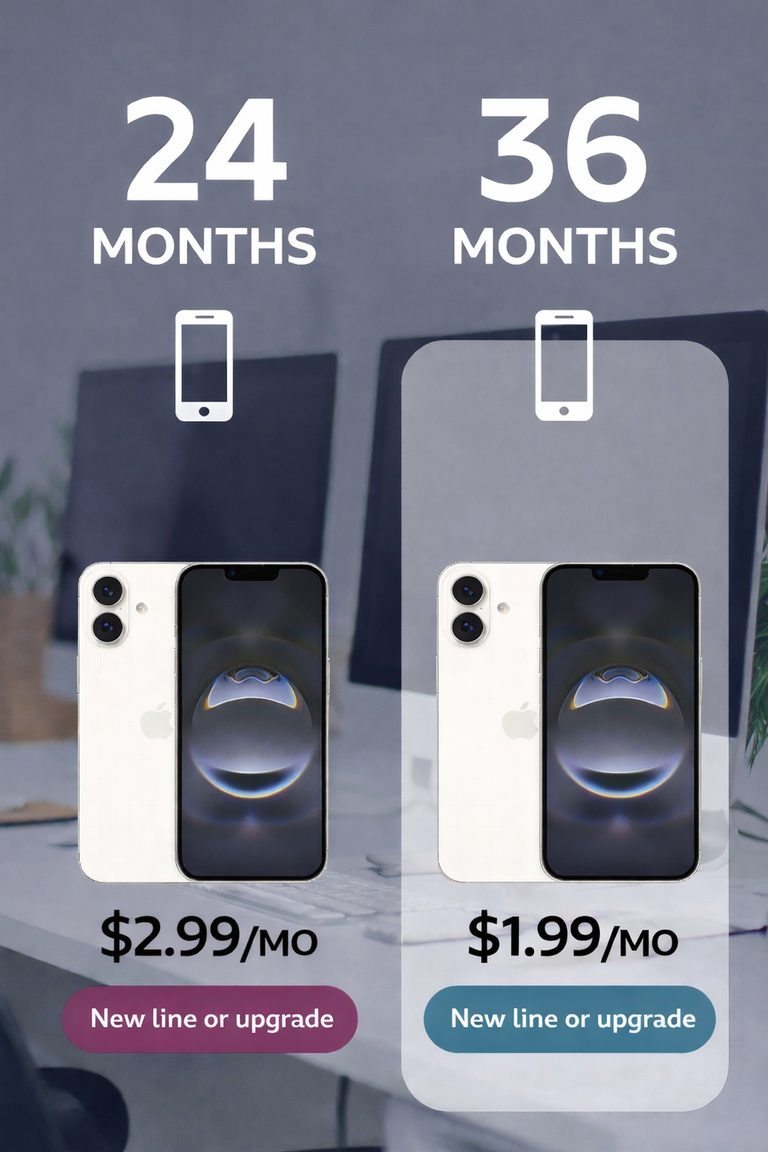
36-month installment
$1.99/mo
24-month installment
$2.99/mo
Yes, 24 months can be a little higher per month — but you’re paid off faster, the credits finish faster,
and you’re upgrade-ready in 2 years instead of 3.
Want to see current promos in one place? Check my AT&T Business Promotions page.
Important: some promos require 36 months
Not every offer lets you choose 24 months. Some new-line promotions are structured to pay out over 36 months — and they
require a standard 36-month installment.
Example: certain new-line bill credit offers (like a $180 bill credit) require 36 months.
For the latest offer details, see
AT&T Business Promotions.
Shared upgrade rule (this catches people later)
If you ever want to do a shared upgrade in the future, the device needs to be on a
regular 36-month installment.
It will not qualify if the device is on 24 months, and it definitely will not qualify on 30 months.
This is one of the biggest reasons we pick the installment term on purpose instead of guessing.
What about the early upgrade add-on?
AT&T offers an optional early-upgrade add-on (often called Next Up) that can let you upgrade early by turning the phone in.
I don’t push it. If you want it, you can choose it — but my default strategy is usually:
pick the right installment term up front, and keep your account upgrade-ready without extra add-ons.
So why ever do 36 months on a “free” phone?
When a phone is effectively $0/mo after bill credits (example: iPhone Air, Samsung XCover Pro 7),
my default question is:
Do you want to be upgrade-ready in 24 months, or do you need 36 months for shared upgrade rules or a required promo term?
If 24 months is allowed and it fits your upgrade plan, getting the credits finished sooner can be a big win.
For current “free phone” offers, see
AT&T Business Promotions.
Trade-ins and faster payoff
When a trade-in covers the cost (or most of it), choosing a shorter term can keep you flexible.
(Trade-in value = TIV.)
Businesses can check a device’s trade-in value at
tradein.att.com.
If you want the current promo options that may stack with trade-ins, see
AT&T Business Promotions.
Want me to recommend the best term for your upgrade?
Tell me what you’re doing (upgrades or new lines), how many lines, and which devices you’re considering.
I’ll recommend the best installment term based on your promo options and upgrade strategy.